Ecommerce SEO Consultant Strategies for Sustainable Online Store Growth

Ecommerce SEO Consultant Strategies for Sustainable Online Store Growth

Ecommerce SEO is not simply about making more product pages appear in search results. A successful online store needs a structure that search engines can understand, content that matches how customers search, technically reliable pages, strong internal linking and a clear path from discovery to purchase.

An Ecommerce SEO Consultant brings those elements together. The consultant evaluates category architecture, product-page quality, technical SEO, keyword demand, content opportunities, backlinks and commercial performance. The objective is to help the right pages appear for relevant searches and attract visitors who are more likely to become customers.

Ecommerce SEO consultant reviewing online store search visibility and sales performance

What Is Ecommerce SEO?

Ecommerce SEO is the process of improving an online store so its category, product and supporting content pages can perform more effectively in unpaid search results. It combines technical SEO, search-intent research, information architecture, content optimization, internal linking and authority development.

Unlike a small service website, an ecommerce site may contain hundreds or thousands of URLs. Products change, filters create additional page variations, categories evolve and out-of-stock items need to be managed carefully. These factors make prioritization especially important.

Businesses looking for an SEO Service for ecommerce should therefore evaluate whether the provider understands online-store architecture and commercial search intent rather than applying a generic SEO checklist.

Why Ecommerce SEO Matters

Search can connect an online store with customers at several stages of the buying journey. Some users are researching a product type, others are comparing options and some are looking for a specific model or feature.

The SEO strategy should reflect those differences. Broad commercial searches may belong on category pages, specific product queries on product pages, and informational questions on guides or articles that support the shopping journey.

The goal is not traffic for its own sake. Organic search is most valuable when it brings relevant visitors to pages that help them make confident purchasing decisions.

The Role of an Ecommerce SEO Consultant

Keyword and Search-Intent Research

Keyword research identifies the language customers use, but the consultant must interpret what those searches mean. A high-volume phrase may be less valuable than a lower-volume query that closely matches a profitable category or product.

A practical ecommerce keyword map separates category, product, comparison and informational intent. This reduces keyword cannibalization and gives each important page a clearer purpose.

Technical SEO

Technical SEO ensures important pages can be crawled, indexed and rendered efficiently. Ecommerce audits commonly review duplicate URLs, canonical tags, faceted navigation, redirects, XML sitemaps, structured data, mobile performance and page speed.

Category and Product Optimization

Category pages often target broad commercial searches, while product pages target more specific demand. Both need useful, differentiated content and strong internal support.

Performance Measurement

A consultant should measure visibility, traffic and commercial outcomes. Rankings can be useful indicators, but they should be interpreted alongside conversion performance, landing-page quality and product availability.

Ecommerce Growth and Sri Lanka’s Digital Transformation

Online retail develops within a wider digital ecosystem. Better connectivity, digital payments, technology adoption and stronger digital skills all make it easier for businesses and customers to transact online.

Sunera Foundation’s article on Sri Lanka’s digital transformation plan discusses the country’s focus on digital infrastructure, transactions, skills and the digitization of major economic sectors. For ecommerce businesses, this wider direction reinforces the importance of building online stores that are easy to discover, secure and usable across devices.

Build Category Architecture Around Real Demand

A strong ecommerce site structure starts with categories customers understand. Categories should reflect meaningful product differences and search demand rather than internal terminology that only the business uses.

Avoid Creating Thin Categories

Not every filter or product characteristic needs an indexable category page. Creating large numbers of thin pages can make the site harder to manage and dilute the quality of the overall search footprint.

Use Descriptive Category Content

Category descriptions should help users understand what is available and what distinguishes the products. The content should support shopping rather than pushing the product grid too far down the page.

Connect Related Categories

Related categories can be linked contextually where it helps shoppers compare alternatives or move to a more specific product group.

Product Page SEO Should Help Customers Decide

Product pages should provide enough information for customers and search engines to understand the item clearly. Reusing the same manufacturer description across many stores makes differentiation more difficult.

Useful Product Information Can Include

  • Key features and benefits.
  • Materials, dimensions or technical specifications.
  • Compatibility or appropriate use cases.
  • Care, maintenance or usage guidance.
  • Delivery, returns or warranty information where relevant.
  • Clear product imagery and descriptive alt text where appropriate.

The purpose is not to expand every description artificially. The page should answer the questions that matter to someone considering that product.

Ecommerce SEO in a Growing Digital Economy

The long-term opportunity for online businesses is tied to wider digital adoption. Sunera Foundation’s coverage of Sri Lanka’s digital economy strategy discusses digital infrastructure, e-commerce, digital services and support for businesses moving online.

For an online store, this creates a clear strategic implication: digital visibility becomes more valuable as more consumers and businesses participate online. SEO can help the store capture relevant demand without depending entirely on paid acquisition.

Internal Linking Is Critical for Large Online Stores

Ecommerce websites often contain many levels of categories, subcategories and products. Internal linking helps users navigate that structure and helps search engines understand which pages are related.

A Best SEO Consultant should evaluate navigation, breadcrumbs, contextual links, related-product modules and supporting content as parts of one internal-linking system.

Useful Internal-Linking Principles

  • Keep important commercial pages reasonably easy to reach.
  • Use descriptive anchors that fit the sentence naturally.
  • Link guides and editorial content to relevant categories or products.
  • Review orphan products or categories.
  • Update links when products are discontinued or categories change.

Mobile Experience and Ecommerce SEO

A responsive design is only the starting point. Ecommerce websites need to work well on smaller screens where shoppers may be browsing product images, comparing options, entering delivery details and completing checkout.

Navigation should be understandable, buttons easy to use, product information readable and pages efficient enough to load under realistic mobile conditions. Heavy scripts and unnecessarily large images can weaken both user experience and site performance.

The Retail Environment Affects Search Performance

SEO data should always be interpreted within the commercial environment. Traffic and conversions can change because of seasonality, product availability, economic conditions or shifts in customer spending—not only because rankings changed.

Sunera Foundation’s article on Sri Lanka’s retail sector and its changing market conditions provides useful context for understanding why ecommerce reporting should consider wider consumer and retail trends alongside SEO metrics.

Technical SEO Challenges in Ecommerce

Technical AreaCommon ProblemStrategic Response
Faceted NavigationLarge numbers of filter URLsIndex only useful search destinations
Out-of-Stock ProductsBroken or unhelpful landing pagesUse retention, replacement or redirects according to context
Duplicate ContentSimilar product or category variationsConsolidate, canonicalize or differentiate strategically
Site SpeedLarge media files and third-party scriptsOptimize templates, assets and integrations
Structured DataIncomplete or inaccurate product markupKeep markup aligned with visible product information

Content Marketing Should Support the Shopping Journey

Blog content can support ecommerce SEO when it answers genuine customer questions and connects naturally to commercial pages. Useful formats can include buying guides, comparison articles, sizing information, gift guides, maintenance advice and product-use tutorials.

Publishing articles only to target more keywords can create a large content archive without meaningful commercial value. Each article should have a clear audience need and a logical relationship with the store’s products or categories.

Backlinks and Ecommerce Authority

Relevant backlinks can support authority and referral traffic, but quality matters more than raw volume. Ecommerce businesses can earn useful links through genuine product reviews, partnerships, expert commentary, original data, digital PR and strong informational resources.

Avoid relying on bulk link packages or unrelated publisher networks. A strong backlink should make editorial sense even if search rankings were not part of the equation.

How to Measure Ecommerce SEO Performance

MetricWhat It ShowsUseful Segmentation
Search ImpressionsOrganic visibilityCategory, product and content pages
Organic ClicksVisits generated from searchBrand vs non-brand queries
Ranking DistributionVisibility across tracked termsCategory and product groups
Conversion RateHow effectively traffic convertsDevice and landing page
Organic RevenueCommercial contributionCategory and customer segment

How to Choose an Ecommerce SEO Consultant

  • Ask how category architecture is developed. It should reflect search demand and shopper behaviour.
  • Review technical ecommerce knowledge. Facets, duplicate URLs, product changes and structured data should be familiar topics.
  • Check the product-content approach. Optimization should help shoppers rather than simply add keywords.
  • Understand internal linking. Category and product relationships should be intentional.
  • Ask about authority development. Backlinks should be relevant and editorially defensible.
  • Review reporting. SEO metrics should connect with ecommerce outcomes where possible.

Working with SEO Expert Sampath Liyanage can provide strategic oversight across technical SEO, content, internal linking and authority development while keeping ecommerce priorities aligned with the store’s actual market and commercial goals.

A Practical Ecommerce SEO Process

  1. Define commercial goals: identify priority products, categories and markets.
  2. Establish a baseline: record organic visibility, traffic, conversions and revenue.
  3. Audit the store: review technical SEO, architecture, products, categories and content.
  4. Map search demand: connect category, product and informational queries to the right pages.
  5. Improve priority pages: strengthen categories, products, metadata and internal linking.
  6. Develop supporting content: create useful guides that support commercial journeys.
  7. Build relevant authority: pursue credible editorial mentions and backlinks.
  8. Measure and refine: update priorities using actual ecommerce performance data.

Conclusion

An ecommerce SEO consultant helps an online store turn search visibility into a more organized commercial growth channel. The strongest strategies connect category architecture, product quality, technical SEO, internal linking, content and authority rather than treating them as separate tasks.

The objective should not be to rank every possible URL. It should be to ensure the pages that matter most are technically sound, aligned with real search demand and useful enough to support a customer’s decision.

When ecommerce SEO is measured against qualified traffic, conversions and revenue—not rankings alone—it becomes easier to prioritize work that supports sustainable online-store growth.

Frequently Asked Questions

What does an ecommerce SEO consultant do?

An ecommerce SEO consultant researches search demand, audits technical SEO, improves category and product pages, strengthens internal linking, develops relevant authority and measures organic performance against commercial goals.

Why are category pages important for ecommerce SEO?

Category pages often match broader commercial searches where customers want to compare several products. Clear structure, useful content and strong internal links can make them important organic landing pages.

How should ecommerce product pages be optimized?

Product pages should provide clear, useful and differentiated information about the item, use descriptive titles and imagery, and connect naturally with relevant categories and supporting content.

Is technical SEO important for online stores?

Yes. Ecommerce sites can create large numbers of URLs through products, filters and categories. Technical SEO helps control crawling, indexation, duplicate content, redirects, structured data and performance.

What metrics should ecommerce SEO track?

Useful metrics include organic impressions, clicks, ranking distribution, conversion rate and organic revenue. Results should be segmented by category, product and content pages where practical.

Are backlinks important for ecommerce SEO?

Relevant editorial backlinks can support authority and referral traffic, but publisher quality, relevance and context matter more than raw backlink volume.

The Original Furby: How It Started the Furby Phenomenon

The Original Furby: How It Started the Furby Phenomenon

We’re taking a trip down memory lane to 1998 when the Furby first captured hearts and became one of the most revolutionary interactive toys of its time.

The launch of this electronic robotic toy was more than just a fad; it marked a significant milestone in the evolution of electronic toys and interactive play.

original furby

These unique creatures, with their big eyes and ability to “learn” language, created unprecedented demand during their initial release. Over 40 million units were sold during the three years of its original production.

In this article, we’ll explore how this phenomenon started, what made it special, and how it evolved into a cultural icon that continues to fascinate collectors today.

The Birth of an Electronic Pet Sensation

Furby’s debut at the 1998 American International Toy Fair was a pivotal moment in toy history. This event marked the beginning of a phenomenon that would captivate children and adults alike. The brainchild of inventors Dave Hampton and Caleb Chung, Furby was more than just a toy; it was an interactive electronic pet.

Dave Hampton and Caleb Chung: The Inventors Behind Furby

The innovative minds behind Furby were Dave Hampton and Caleb Chung. Furby Toy Shop to be an interactive creature that could engage with its owner, creating a unique bond. Their invention was not just a toy but a companion that could adapt and evolve.

Tiger Electronics and the 1998 Launch

Tiger Electronics took a significant risk in bringing Furby to market, but their gamble paid off spectacularly. Launched at $35, Furby was initially affordable for many families. However, the demand soon skyrocketed, making it a highly sought-after item during the 1998 holiday season. Some key points about the launch include:

  • The initial retail price made Furby accessible to many.
  • Overwhelming demand led to a secondary market with prices soaring to several times the retail value.
  • Furbies were sold for over $300 in some cases, with sellers assigning rarity values to different aesthetic varieties.

What Made the Original Furby Special

The original Furby’s innovative features set it apart from other toys of its time. Its ability to interact with users and adapt to its environment was a significant factor in its success.

One of the standout features of the original Furby was its language learning capability. It could transition from speaking “Furbish” to English, creating an illusion of learning and adapting to its user’s interactions.

Furbish to English: The Learning Language Feature

The Furby’s language feature was a marvel of its time. It started by speaking entirely in “Furbish,” a language that sounded like a mix of gibberish and real words, and gradually began to incorporate English words and phrases as it “learned” from its interactions.

This feature not only fascinated children but also made the toy seem more alive and responsive. The gradual transition from “Furbish” to English was achieved through sophisticated programming that allowed the Furby to simulate learning.

Interactive Technology and Sensors

The original Furby was equipped with advanced sensors and interactive technology. It could detect light and dark, respond to touch, and even react to sound. This interactivity was made possible by a simple yet ingenious system of cams and gears powered by a single electric motor.

FeatureDescription
Light SensorsDetected changes in lighting conditions
Touch SensorsResponded to petting or tickling
Sound DetectionReacted to environmental sounds
Infrared PortAllowed communication between Furbys

The combination of these features and technologies made the original Furby a truly unique and captivating toy. Its ability to interact with users and its environment in multiple ways created a sense of companionship that was revolutionary for its time.

Inside the Original Furby

Delving into the original Furby reveals a complex interplay of technology and design that captivated many hearts during the holiday season of 1998. At its core, the Furby was an electronic, interactive creature that could respond to its environment and interact with users.

Technical Specifications and Design

The original Furby was equipped with advanced technology for its time, including infrared sensors and a range of pre-programmed sounds and movements. It could understand and respond to various stimuli, creating an illusion of intelligence and interaction. The Furby’s design allowed it to gradually learn English, starting with “Furbish” and progressing to simple phrases.

A detailed technical schematic of the original Furby plush toy, showcasing its intricate internal mechanisms and components. The image is rendered with a clean, technical aesthetic, using a muted color palette and precise line work to highlight the various motors, sensors, and circuit boards that give the Furby its unique behaviors and expressions. The perspective is a cutaway view, revealing the Furby's inner workings in an exploded, isometric layout, allowing the viewer to clearly see and understand the complex engineering that brought this iconic toy to life.

The Misconceptions and NSA Ban

One of the most fascinating chapters in Furby history was the January 1999 ban by the National Security Agency (NSA), which prohibited the toys from their facilities due to concerns over potential recording and repetition of classified information. However, this concern was based on a misconception – Furby wasn’t actually recording or learning from what it heard; it was pre-programmed to gradually replace Furbish words with English phrases. Roger Shiffman, the owner of Tiger Electronics, had to publicly clarify that “Furby has absolutely no ability to do any recording whatsoever.”

The NSA’s ban highlighted how revolutionary Furby’s simulated learning was – it was so convincing that even government security experts believed the toy possessed capabilities beyond what was technically possible at that price point.

Varieties of the Original Furby

Beyond the original, the Furby family grew to include a range of exciting variations. As the Furby craze continued to sweep the nation, Tiger Electronics responded by expanding the line with new and innovative models.

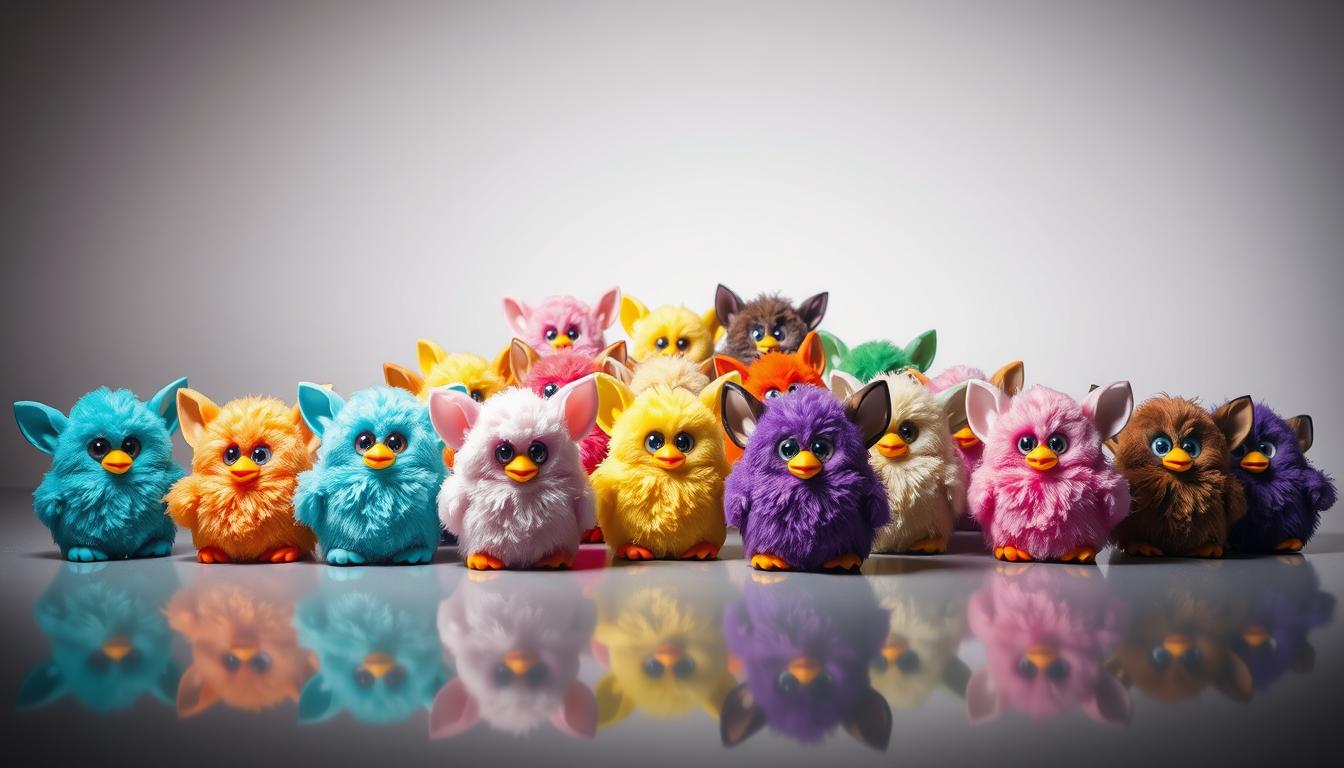
Color Variations and Special Editions

The original Furby was available in several colors, but Tiger Electronics didn’t stop there. They released numerous special editions, catering to diverse consumer preferences. The introduction of new colors and designs helped keep the product fresh and exciting for consumers. This strategy not only attracted new customers but also encouraged existing Furby owners to collect more.

A vibrant display of the original Furby's color variations, showcased in a stylish, studio-lit arrangement. In the foreground, an assortment of Furbies in classic hues like teal, pink, and purple sit atop a sleek, reflective surface, their plush textures and expressive features illuminated by soft, directional lighting. In the middle ground, additional Furbies in complementary shades of yellow, orange, and green are arranged in a visually striking pattern, creating a sense of depth and visual interest. The background features a clean, minimal setting, allowing the Furbies to take center stage and accentuating their distinct, collectible nature. The overall composition captures the whimsical, nostalgic charm of the original Furby, inviting the viewer to appreciate the variety and appeal of this iconic 90s toy.

Furby Babies and Friends

In 1999, the Furby Babies line was introduced, offering a new twist on the original. Furby Babies were smaller, had higher-pitched voices, and learned English more quickly. They came in 24 different colors, all featuring white eyelashes and one of six possible eye colors. The Furby Friends line further expanded the universe with character-based editions like Gizmo Furby from “Gremlins,” Yoda Furby from “Star Wars,” and E.T. Furby. These character-based Furbies brought beloved movie characters into the interactive pet format, appealing to fans of all ages. Another unique addition was Shelby, a clam-like friend for Furby released in 2001, which featured improved memory and could communicate with both original Furbys and Furby Babies.

The expansion of the Furby line demonstrated Tiger Electronics’ commitment to building a complete Furby world. By creating an entire ecosystem of interactive pets that could communicate with each other, they significantly enhanced the play value and appeal of the Furby brand.

The Evolution of Furby Through Generations

The Furby phenomenon has undergone significant transformations since its inception, with each generation bringing new and exciting features to the table. Over the years, Furby has evolved to incorporate innovative technologies, changing consumer preferences, and emerging trends.

The evolution of Furby can be seen in several key models released over the years. Let’s take a closer look at some of the notable generations.

Emoto-Tronic Furbies (2005-2007)

The Emoto-Tronic Furbies, released between 2005 and 2007, introduced a new level of emotional expression. These Furbies were capable of displaying a range of emotions, making them more relatable and endearing to children.

LCD-Eyed Furbies (2012-2016)

The LCD-Eyed Furbies, released between 2012 and 2016, featured advanced LCD eyes that enabled more sophisticated interactions. This generation was part of the Furby Boom series, which allowed for app connectivity and expanded play options.

The 2023 Furby Revival

In 2023, Hasbro announced the return of the Furby line with exciting new features. The latest Furby comes in three varieties: purple, coral, and a special edition tie-dye version available in France, Great Britain, and Ireland. Unlike its predecessors, the 2023 Furby has drawn eyes instead of LCD screens and features glowing ears that respond to petting, shaking, and feeding. It also comes with bundled accessories like necklaces with beads and combs.

Furby GenerationRelease YearsNotable Features
Emoto-Tronic Furbies2005-2007Emotional expression
LCD-Eyed Furbies2012-2016LCD eyes, app connectivity
2023 Furby Revival2023Glowing ears, drawn eyes, physical interaction
A collection of Furby figurines showcasing the evolution of the iconic toy over generations. In the foreground, an original 1998 Furby model with its signature large eyes and furry exterior stands proud. Behind it, subsequent Furby designs appear, each iteration exhibiting subtle changes in shape, color, and features - from the sleeker 2005 models to the more expressive 2012 versions. The Furbies are arranged in a museum-like display, bathed in warm, theatrical lighting that casts dramatic shadows, creating a sense of reverence and nostalgia. The background is a muted, minimalist setting, allowing the Furbies to take center stage and highlight their transformative journey through the decades.

The 2023 Furby revival represents a fascinating return to the toy’s roots while incorporating modern expectations for interactive play. With five voice-activated modes and over 600 responses, the new Furby offers a more sophisticated interaction than ever before. By focusing on physical interaction and simplifying technology, Hasbro has created a more engaging toy that demonstrates the enduring appeal of the Furby concept.

Collecting Original Furbys in Today’s Market

For collectors and enthusiasts, the original Furby remains a highly sought-after item in today’s market. As the years have passed since its initial release, the Furby has become a nostalgic symbol of the late 90s, driving its demand among collectors.

The first step in collecting original Furbys is to identify authentic units. This involves checking for specific characteristics such as the correct Furbish language patterns, proper sensor responses, and the distinctive electronic sounds.

Identifying Authentic Original Furbys

To ensure authenticity, collectors should look for the trademark “Furby” logo, check the packaging for Tiger Electronics branding, and verify that the device functions as intended. Authentic Furbys also have a unique serial number on their packaging or on the device itself.

Rare and Valuable Furby Editions

Certain editions of the original Furby are more valuable than others due to their rarity or special features. For example, limited edition Furbys or those with unique color schemes can command higher prices.

EditionRarityEstimated Value
Standard FurbyCommon$50-$100
Limited Edition FurbyRare$200-$500
Special Color FurbyUncommon$100-$300

Care and Preservation Tips

To maintain or increase the value of an original Furby, proper care and preservation are essential. We recommend storing Furbys in a cool, dry environment away from direct sunlight. Regularly check the battery compartments and remove batteries during long-term storage to prevent corrosion.

Key Care Tips: Use a soft, dry cloth for cleaning, avoid liquids or cleaning products, and keep the Furby in its original packaging if possible. By following these guidelines, collectors can ensure their original Furbys remain in top condition.

A dimly lit room, filled with the nostalgic glow of vintage electronics. In the foreground, a collection of original Furbys - each one a unique testament to the 90s craze. The plush, rounded forms of the Furbys are carefully arranged, their big eyes and fuzzy textures reflecting the warm, amber lighting. In the middle ground, a wooden display cabinet holds an assortment of Furby accessories and memorabilia, from vintage packaging to rare limited editions. The background is shrouded in shadows, creating a sense of mystery and intrigue around this treasure trove of Furby collectibles. The image conveys a mood of reverence and appreciation for the iconic toy that captured the imagination of a generation.

The Enduring Cultural Impact of Furby

As we reflect on the Furby phenomenon, it’s clear that its influence extends far beyond the toy industry. The original Furby’s cultural impact is a testament to the innovative design and interactive technology pioneered by Tiger Electronics.

The Furby craze of the late 1990s may have subsided, but its legacy continues to be felt. Over 12 million Furbys were sold internationally from October 1998 to December 1999, a staggering number that highlights the toy’s massive appeal. The demand for Furbys was so intense that it changed retail practices, with stores implementing waiting lists and purchase limits.

Today, the original Furby remains a sought-after collector’s item, with rare editions commanding premium prices on the resale market. The Furby line’s evolution through different generations demonstrates how a toy concept can adapt to changing technology while maintaining its core appeal. As we look back, it’s evident that the original Furby’s impact will be felt for generations to come, a true testament to its place in the world of toys and beyond.

FAQ

What was the price of the Original Furby when it was first released in 1998?

The Original Furby was launched at a price point around $30-$35, which was relatively affordable for a high-tech toy at that time.

What made the Furby so popular during the holiday season of 1998?

The Furby became a must-have gift during the 1998 holiday season due to its unique interactive technology and the ability to learn and adapt, creating a sensation among both kids and adults, which led to high demand and subsequent shortages.

How many colors was the Original Furby available in when it was first launched?

The Original Furby was initially available in several colors, including various pastel shades, which added to its appeal and collectibility.

Who were the inventors behind the Furby?

The Furby was invented by Dave Hampton and Caleb Chung, whose innovative ideas and designs brought this electronic pet to life under the umbrella of Tiger Electronics.

What is the resale value of Original Furby models today?

The resale value of Original Furby models can vary significantly depending on their condition, rarity, and whether they are part of a special edition or line. Some rare models have fetched high prices due to their collectibility and the nostalgia they evoke.

How has the design and technology of Furbies evolved over the years?

Over the years, Furbies have undergone significant transformations, from the introduction of new generations like Emoto-Tronic and LCD-Eyed Furbies to the latest revival in 2023, each bringing advancements in technology and design, keeping the brand fresh and exciting for new and old fans alike.

Are there any rare or limited edition Furbies that are highly sought after by collectors?

Yes, certain rare and limited edition Furbies, including special color variations and Furby Babies, are highly prized by collectors, sometimes commanding a premium price on the resale market due to their uniqueness and the demand for them.

Sri Lanka’s Rupee Closes Stronger at 293.00/20 to the Dollar

Sri Lanka’s Rupee Closes Stronger at 293.00/20 to the Dollar

The Sri Lankan Rupee showed new strength on Wednesday. It closed at 293.00/20 against the US Dollar, up from 293.50/60. This change signals a positive shift in the currency exchange rate.

The forex market performance matches the nation’s ongoing economic recovery efforts. Bond yields stayed steady amid the Rupee appreciation. A bond due 15.12.2026 closed at 10.60/80 percent.

Another bond maturing on 15.12.2027 closed at 11.45/60 percent. This stability in bonds highlights the improving health of the Sri Lankan economy.

Sri Lanka's Rupee Closes Stronger at 293.00/20 to the Dollar

The Rupee’s rise matches a drop in the central bank’s bill stock. As the exchange rate grows, importers may benefit from better rates. This could boost trade and business in the nation.

The Rupee’s growth and steady bond yields paint a good picture. They show Sri Lanka’s economic prospects are improving. The currency’s strength proves that financial measures are working.

Recent Rupee Performance Against the US Dollar

The Sri Lankan rupee is getting stronger against the US dollar. On Thursday, it was 292.80/85 against the dollar, up from 293.00/20 the day before. This shows more trust in the local currency.

Rupee Strengthens to 292.80/85 on Thursday

On Thursday, the rupee opened at 293.05/15 to the dollar. This was the same as Wednesday’s closing rate. The stable exchange rate helps businesses and investors.

The rupee’s rise to 292.80/85 during the day boosted confidence in the local currency. This stability is good for economic growth and investor trust.

Rupee Remains Stable at 293.05/15

The rupee’s steady performance is important to note. Its unchanged opening rate shows consistency. This stability helps maintain investor confidence and supports economic growth.

The dollar’s selling rate fell below Rs. 300 for the first time since June 8, 2023. It reached Rs. 299.35, with a buying rate of Rs. 290.30.

The rupee’s strength against the dollar is good news. It improves Sri Lanka’s economic outlook and ability to attract foreign investment.

Bond Yield Trends in Sri Lanka

Sri Lanka’s bond market shows interesting trends lately. Bond yields remain steady despite the rupee’s rise against the US dollar. Analysts are watching bonds closely to assess the economy and investment chances.

Bond Yields Remain Steady Amid Rupee Appreciation

On October 30, 2024, the January 15, 2027 bond was quoted at 10.79/83 percent. The March 15, 2028 bond recorded yields of 11.70/75. These numbers show a stable bond market as the rupee strengthens.

The rupee’s rise is due to increased foreign investment and a better economic outlook. This stability is noteworthy given the currency’s recent performance.

Treasury Bond Auction Impacts on Yields

The upcoming Treasury Bond auction will likely affect bond yields soon. The central bank plans to issue 95 billion rupees worth of bonds. This auction will reveal demand for government securities and market liquidity.

The auction’s outcome may influence the yield curve. This curve shows the link between bond yields and their maturities. It’s a key indicator for investors.

Investors and analysts will watch bond yields, auctions, and the rupee’s performance closely. Understanding these trends helps market participants make smart decisions. It allows them to navigate Sri Lanka’s bond market with more confidence.

Sri Lanka Dominates Hong Kong at Asian Netball 2024

Sri Lanka Dominates Hong Kong at Asian Netball 2024

In a gripping game of skill and determination, Sri Lanka showed their power in the 2024 Asian Netball Championship Semi-Final. They achieved a Sri Lankan Sports Triumph against Hong Kong, winning 71-47. This victory highlights their strong position in Asian Netball, bringing them closer to championship success.

The battle took place at the Koramangala Indoor Stadium in Bangalore. Sri Lanka took the lead early, ending the first quarter ahead at 18-9. By halftime, they solidified this lead to 36-21. Their skills on the court were clear, pushing them nearer to winning another major title.

Key Takeaways

  • Sri Lanka’s formidable performance against Hong Kong highlighted their championship caliber.
  • The team’s success is a shining example of the prowess of Netball in Asia.
  • Thishala Algama’s standout performance with a 95% shooting accuracy played a significant role in the victory.
  • Sri Lanka’s quest towards a championship hat-trick was evident in their strategic gameplay.
  • Their dominant semi-final win serves as a stepping stone for Sri Lanka in the International Netball Showdown.
  • This victory marked a high point for Sri Lankan Sports Triumph on an international stage.

Sri Lanka’s Netball Team Dominates Hong Kong in 2024 Asian Championship

The Sri Lankan national netball team scored a big win against Hong Kong in the semi-finals of the 2024 Asian Netball Championship. This victory shows the skilled netball players of Sri Lanka and their dedication to women’s sports excellence.

Gayanjali Amarawansa and Thishala Algama’s Impressive Performance

Gayanjali Amarawansa and Thishala Algama led the team to success. Algama’s amazing shooting skills helped the team win the regional championship. Amarawansa played brilliantly, making plays that increased their lead.

Defensive Strategies: Gayani Dissanayake & Rashmi Perera’s Role

Gayani Dissanayake and Rashmi Perera played key roles in defense. They stopped Hong Kong from scoring many times. Their great defense work gave Sri Lanka’s attackers the chance to be bold in their game.

Strong Start and Sustained Lead by Sri Lanka Throughout the Game

Sri Lanka took the lead early in the game. By half-time, they had a big advantage thanks to their strong plays. Sri Lanka kept their lead despite Hong Kong’s comeback tries, ensuring their place in the final.

Sri Lanka’s success in the 2024 Asian Netball Championship highlights their strong training and development programs. This win is more than just a sports victory; it’s a big moment in Sri Lanka’s sports history. It adds to the legacy of women’s sports excellence in the area.

Building Up to the Semi-Final: Sri Lanka’s Journey in the Championship

Sri Lanka’s journey to the semi-finals has been filled with remarkable wins. They’ve shown great skill and determination from the start. Their journey is a quest for sporting honor.

Group Stage Triumphs and Dominant Quarter Performance

Sri Lanka started strong with big wins against the Maldives and the Philippines. They set an early tone of confidence with these games. Their game against Chinese Taipei was a standout, ending with a massive win.

Tactical Mastery: Formations and Player Rotations

The team’s smart use of player rotations and formations has been key. This strategy wasn’t just about talent. It involved deep thinking and planning, which helped them reach the semi-final.

Sri Lanka’s Winning Streak Propelled by Skilled Netball Players

The heart of Sri Lanka’s success lies in its talented players. Their performance has been top-notch, leading to a strong winning streak. This journey is a testament to their determination and skill, as they prepare for more challenging games ahead.

Sri Lanka’s progress carries the dreams of victory and national pride. The competition draws the attention of the entire country, hoping for more success. The team represents not just sports achievement but also Sri Lanka’s rich culture.

Impacts of Skilled Play: Breaking Down Game Statistics

The performance of Sri Lanka’s Netball Team at the 2024 Asian Championship was amazing. They showed great skill and strategy in their games. This led to their win against Hong Kong Netball.

Analyzing Shooting Accuracy: Thishala Algama’s Standout Stats

Thishala Algama’s shooting was key for Sri Lanka’s Netball Team. She scored 54 goals from 57 tries. Her 94.7% shooting rate highlights her skill and the team’s hard work.

Quarter by Quarter: How Sri Lanka Cemented Their Victory

Sri Lanka got stronger every quarter. They used smart moves and teamwork to beat Hong Kong. The second quarter was when they really took the lead, showing their strength in the game.

Team Comparisons: Evaluating Sri Lanka and Hong Kong

Sri Lanka and Hong Kong both had a 90% shooting accuracy in the 2024 Asian Championship. But Sri Lanka made more successful shots. Thishala Algama played a big part in their 24-goal win. This shows Sri Lanka’s strong strategy and skill.

Sri Lanka shines in Women’s Sports Excellence and on global stages like the Venice Biennale. Their success in sports and arts shows their dedication to excellence.

Looking Towards the Final: Sri Lanka’s Preparation for Glory

Sri Lanka’s netball team is gearing up for the Asian Netball 2024 championship final. They aim to secure a victory that would go down in history. Their journey to the final showcases their skill, tactics, and sheer determination. Despite the Netball Federation of Sri Lanka’s dissolution, their progress shows their strong spirit and ambition.

The team’s win over Singapore with a score of 72-70 at the Sri Lanka Invitational International Netball Tournament was thrilling. Tharjini Sivalingam’s shooting accuracy, hitting 96% of her shots in the final, demonstrates the team’s high skill level. However, there are worries about their strategy focusing too much on height. Yet, it’s this tactical play that has brought them success and will be vital for facing future challenges.

The team draws inspiration from Sri Lanka’s rich traditions and resilient spirit. They are especially inspired by the Kandy Esala Perahera festival, a symbol of the country’s ability to overcome and flourish. As they prepare for the final against Hong Kong, every move and strategy reflects their dedication to excellence and unity. This steadfast commitment is what might lead them to achieve a significant win on the international stage.

Sri Lanka Integrates Artificial Intelligence into School

Sri Lanka Integrates Artificial Intelligence into School

Sri Lanka’s Ministry of Education and Microsoft are teaming up to revolutionize education. They’re bringing Artificial Intelligence (AI) and Machine Learning (ML) into the national school curriculum development process. This partnership aims to make AI education accessible to all students and teachers.

The program will start from grade eight. The government has set aside Rs 1 billion for AI projects, including a national AI center. AI Clubs will be set up in 100 schools, reaching about 300,000 students.

Microsoft will train 100 teachers and support online learning activities. Students can access resources through the AIClub Navigator platform. The Schools Fiberization project has already connected 1,000 schools, paving the way for advanced educational technology.

AI skills are becoming crucial for future jobs. A Microsoft and LinkedIn study shows that many leaders won’t hire people without AI skills. By embracing AI in education, Sri Lanka is preparing its youth for tomorrow’s workforce.

Ministry of Education and Microsoft Sign MoU to Introduce AI in Schools

Sri Lanka’s Ministry of Education has partnered with Microsoft to bring AI into schools. This collaboration will introduce AI and Machine Learning into the curriculum. The initiative starts with a pilot project in select schools nationwide.

Pilot Project to Roll Out in 20 Selected Schools Across 20 Districts

The pilot will launch in 20 schools, covering all nine provinces. Students in Grade 8 and above will explore AI in their IT classes. The program aims for full implementation by 2025.

The signing ceremony on March 19 included key figures. Among them were Dr. Susil Premajayantha, Minister of Education, and Julie J. Chung, US Ambassador to Sri Lanka.

  • Dr. Susil Premajayantha, Minister of Education
  • Kanaka Herath, State Minister of Technology
  • Julie J. Chung, United States Ambassador to Sri Lanka
  • Puneet Chandok, President of Microsoft India and South Asia
  • Representatives from various educational institutions, such as D.S. Senanayake College, Colombo

Dedicated Microsoft Team to Support Online Educational Activities

Microsoft will provide its 365 platform for secure communication and collaboration. This tool will enhance online learning for students in the chosen schools.

The partnership aims to empower learners and teachers for the AI era. It uses a ‘train the trainer’ model to spread knowledge effectively.

By integrating AI into education, Sri Lanka prepares its youth for the future. This forward-thinking approach equips students with skills for a rapidly changing world.

Transforming Education System with AI and Machine Learning

Sri Lanka’s education system is embracing AI and machine learning. This marks a big step in the country’s digital growth. Global Microsoft Education teams and the National Institute of Education (NIE) have created a comprehensive curriculum. It aims to help students and teachers thrive in the AI era.

The curriculum covers key topics like machine learning and robotics. These skills will prepare students for an AI-driven world. The project will start in 20 schools across all nine provinces.

A ‘train the trainer’ model will ensure teachers can share AI knowledge. Microsoft 365 will provide a safe space for online learning. This platform will help both students and teachers work together.

AI can transform Sri Lanka’s education system in many ways. It can solve problems like limited resources and unequal access. AI can tailor learning to fit different styles and needs.

This technology can also bring education to remote areas. It promotes inclusive learning and helps develop rural regions. The teamwork between the Ministry of Education and Microsoft is a big step forward.

FAQ

What is the collaboration between the Ministry of Education in Sri Lanka and Microsoft?

Sri Lanka’s Ministry of Education and Microsoft have signed an MoU. They aim to integrate AI and Machine Learning into the national school curriculum. This effort seeks to transform the country’s education system.

When will the pilot testing phase of the AI integration begin?

The pilot testing will start from grade eight and above. It will involve 20 selected schools across 20 districts in Sri Lanka.

What platform will be provided as part of the MoU signing?

The MoU includes the provision of the Microsoft 365 platform. It will serve as a secure hub for students and teachers to communicate and collaborate.

How will the pilot project be implemented in the selected schools?

The project will roll out in 20 chosen schools. These schools will receive conducive classrooms and necessary technical equipment. A Microsoft team will support online educational activities.

Who developed the comprehensive curriculum for the AI integration?

Global Microsoft Education teams and Sri Lanka’s National Institute of Education (NIE) developed the curriculum. They worked together to create a comprehensive learning plan.

How will the pilot program empower learners and educators?

The pilot program will follow the ‘train the trainer’ model. It will prepare both learners and educators to navigate the AI era confidently.

What is the goal of integrating AI and ML into the national school curriculum?

The goal is to make AI accessible to everyone. It aims to empower learners and educators in the AI era. Ultimately, it seeks to transform Sri Lanka’s education system.